About Ragas
Samay Chakra or Time Cycle of Raags in Hindustani Classical Music
In Hindustani classical music, each raag is rendered only at a specific time. The time of the raag depends on the ‘Vaadi Swar’ and the ‘Anuvadi Swar’. This is so, as each raag with its particular swar is more effective if performed at a particular time. It is supposed to enhance the ras (mood) of the raag that the artist is responsible for evoking.
But some raags are seasonal in nature. For example, raags that belong to the Malhar category can be sung at any time during the monsoon season. The traditional associations with respect to the season are Monsoon – Raag Megh; Autumn – Raag Bhairav; Winter – Raag Malkauns; and Spring – Raag Hindol.
Image Credits: ITC SRA
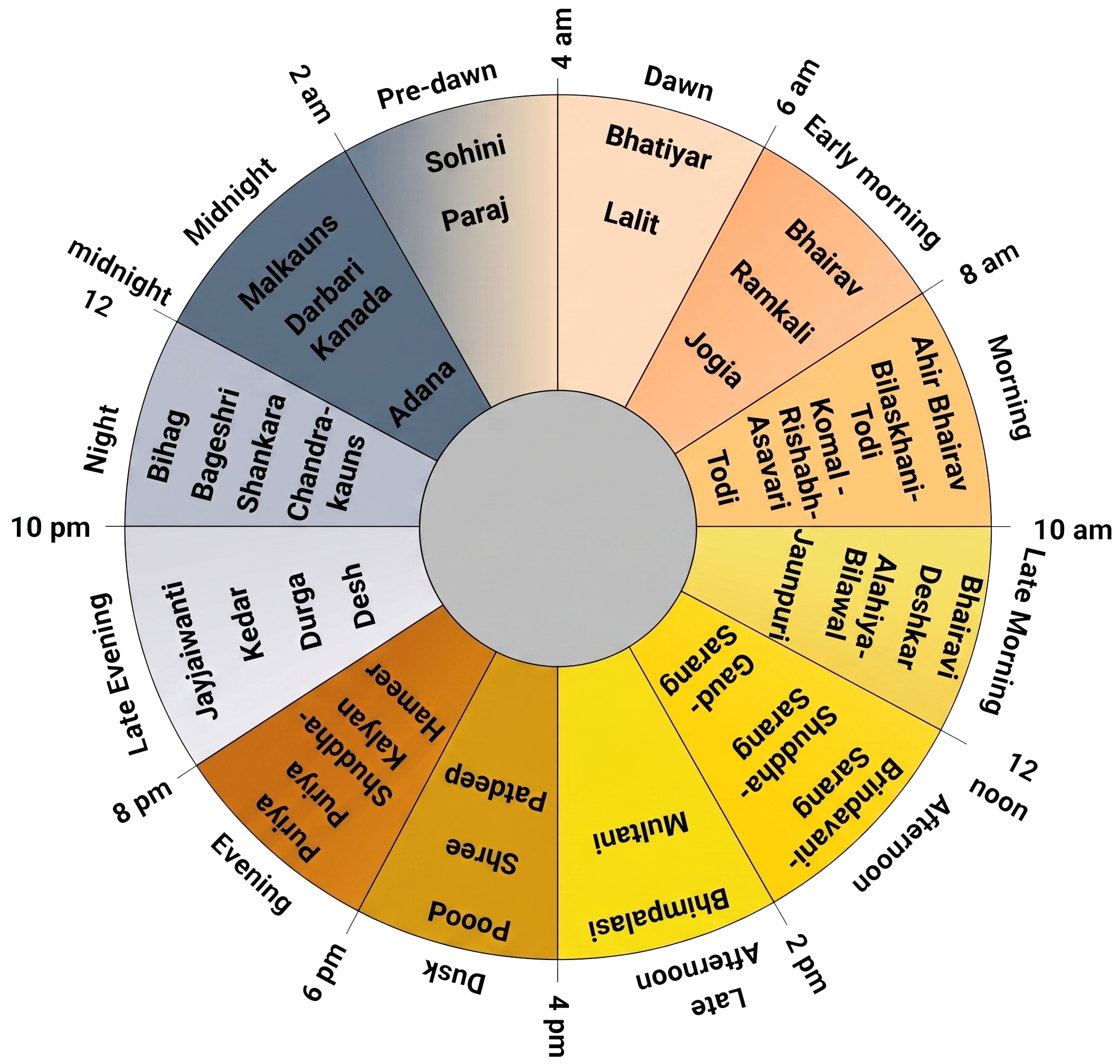
The 24 hours of a day are divided into 2 parts
1. Poorva Bhaag
From 12 AM to 12 PM – This is called “Poorva Bhaag”, and raags sung in this period are called “Poorva Raags”
2. Uttar Bhaag
From 12 PM to 12 AM – This is called “Uttar Bhaag”, and the raags in this period are called “Uttar Raags”.
The part of the saptak (octave) from Sa to Ma (Sa Re Ga Ma) is called the “Poorvang” (earlier part) of a raag, and from Ma to the taar saptak Sa (Pa Dha Ni Sa) is called the “Uttarang” (later part) of the raag.
• Poorvang Vaadi Raag •
The raags in which the vaadi swar lies in the poorvang are called ‘poorvang vaadi raag’. These raags are rendered in the poorva bhaag of the day, i.e., 12 AM to 12 PM.
• Uttarang Vaadi Raag •
The raags in which the vaadi swar lies in the uttarang are called ‘uttarang vaadi raag’. These raags are sung in the uttar bhaag of the day, i.e., 12 PM to 12 AM
So if we know a vaadi swar of the raag,
we can estimate the time the raag will be rendered.